Cap sizes & density · for wig stores
Wig Cap Sizes & Density: Measured on Her Head, Approved on a Sample
Take five measurements with a soft tape and name the look you want: lighter, as listed or fuller. Your wig specialist reads both against the style, and both are fixed when you approve the sample.
- Size and density confirmed per style, read back first
- Nape straps in every cap; clips when glueless
- Six daylight views per sample, size label included
- Held on every reorder from the approved sample

Two of six fields
Cap Size and Density, Confirmed per Style
Every wig is described by six fields. Style, shade and cap construction you pick by name; length, density and cap size are confirmed per style, because availability depends on the cut.
- Style
- Picked by name
- Shade
- Picked by name
- Cap construction
- Picked by name
- Length
- Confirmed per style
- Density
- Confirmed per style, read back to you
- Cap size
- Confirmed per style, read back to you

- Cap size
- How the cap fits the head: around the hairline, over the crown, at the temples, behind the ears and at the nape. It decides whether the wig sits still, lies flat at the front and closes at the back of the neck.
- Density
- How much hair is on the cap, read as how full the wig looks. It changes across the head: thinner toward the forehead, enough at the crown to cover the cap, lighter at the ends on longer styles.

Both are read back to you before sampling and fixed when you approve the sample. Cap construction, the field that decides how light the cap is and how it holds, is set out on Wig Cap Construction.
Two ways sizes arrive
Cap Size Buyers — Stores Measuring Clients, Distributors Planning Ranges
The stores that use this guide send sizes in two ways: one client at a time, or a set of sizes for a shelf.
One client at a time
High-end wig boutiques
Measure a client at a consultation, order a sample made to her head, then stock the styles that fit well across their clients.
Medical wig shops
Measure a client before or after hair loss, under the store's own reference number, with no wearer name. The full route is on Medical Wigs.
Hair salons and stylists
Measure in the chair and fit the sample on the client before they cut it in.
Custom wig studios
Send measurements with reference images, so the size is developed with the rest of the wig.


A set of sizes for a shelf
Private label brands
Decide which cap sizes each style in the line is offered in, each one confirmed on a sample.
Distributors and wholesalers
Plan which sizes to carry per style for the stores you supply, and list them on the quote.


Measure · five points, one soft tape
Wig Cap Size Measurement — Five Points Taken With a Soft Tape
We do not meet the wearer, so cap size starts with the five measurements your store takes. Each one matches a place where the cap can sit loose or tight, so a measurement and a fit mark always refer to the same part of the head.
Before you measure
- Use a soft tailor's tape, snug against the head but not pulled tight.
- Measure her as she will wear the wig: own hair flattened, wrapped or pinned, or a bare scalp. Note a client measured before hair loss.
- Take each measurement twice. If the two readings differ, send both.
- Write the unit you measured in, centimeters or inches, next to the numbers.

Circumference
Start at the hairline in the center of the forehead, run the tape just above the ears, down to the nape hairline and back to the start. The tape sits where the edge of the cap will sit. This is the main measurement for cap size.
Off on the sample: whole cap loose or tight
Front to nape
From the hairline at the center of the forehead, over the top of the head and the crown, to the nape hairline. This decides whether the front edge sits at her hairline while the back reaches the nape.
Off on the sample: front edge pulled back, or a gap at the nape
Ear to ear over the top
From the hairline in front of one ear, across the top of the head, to the same point in front of the other ear. This shows how the cap fits over the top and down to the ears.
Off on the sample: cap lifting over or behind the ears
Temple to temple around the back
From one temple, around the back of the head at its fullest point, to the other temple. This shows how the cap holds at the sides and the back of the head.
Off on the sample: loose or pressing at the temples
Nape width
Across the nape hairline at the back of the neck, from one side to the other. This shows how the lower edge of the cap and the straps sit at the neck.
Off on the sample: lower edge lifting or pulling
Measurement → fit mark → view
Five Measurements, Five Fit Marks — Where Each Shows on the Sample
A measurement and a fit mark name the same part of the head, so you check each one in the same daylight photo of the sample.
Front Side Back 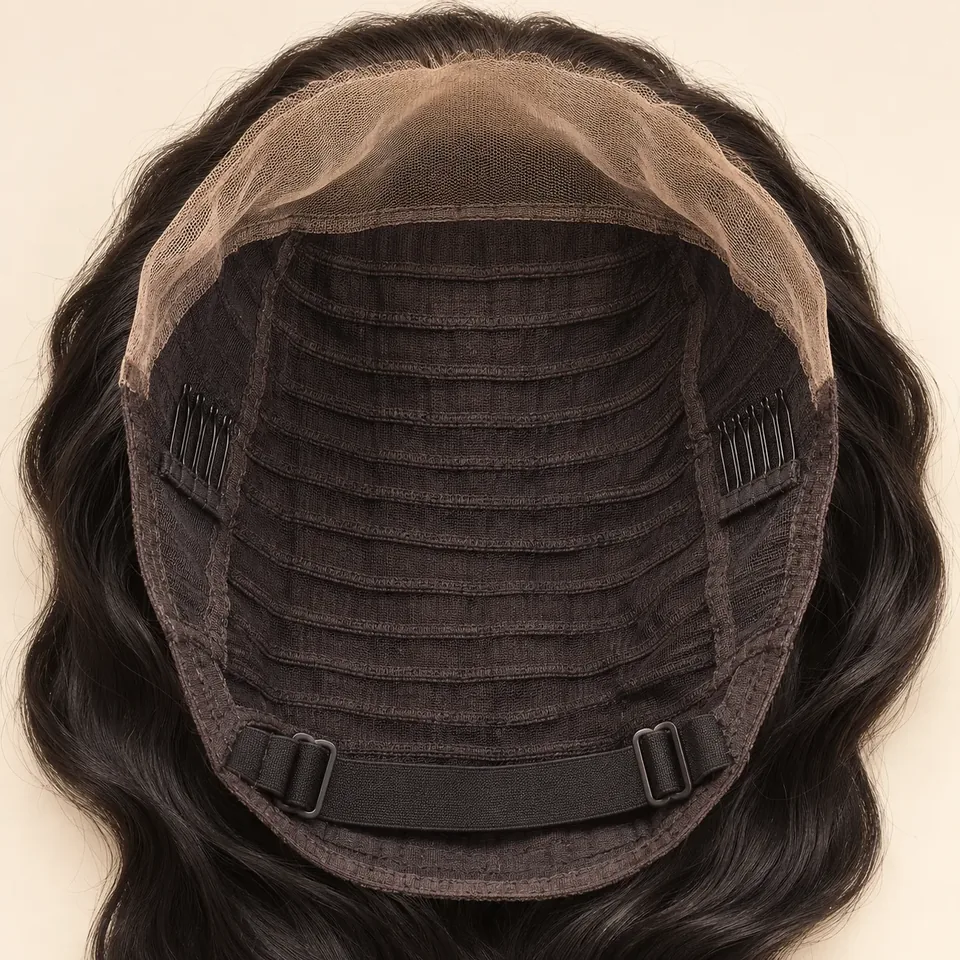
Cap


| Measurement | Where a fit problem shows on the sample | View to read it in |
|---|---|---|
| Circumference | Whole cap loose or tight | Front and back views, on the head |
| Front to nape | Front edge pulled back, or the cap gapping at the nape | Side view |
| Ear to ear | Cap lifting over or behind the ears | Side view |
| Temple to temple | Cap loose or pressing at the temples | Front view |
| Nape width | Lower edge lifting or pulling at the neck | Back view, cap interior |
What this gives you: a size request built from your client's head, in the same places you will later check the sample.
Measurements → one cap size
Measurements to Cap Size — Read Back by Your Wig Specialist
The wig specialist who looks after your account turns your measurements into a cap size before anything is made.
What your wig specialist does
- Reads the measurements against the style
- Cap sizes are confirmed per style from our supply data; the five measurements are checked against the sizes available for the style you named.
- Reads the size back
- The cap size goes back to you in writing with style, shade, cap construction, length and density, as one line of your sample list. Nothing goes to the workshop until you confirm it.
- Asks when something is missing or unclear
- A circumference with no unit, two readings far apart, or no note on hair or bare scalp: you are asked before sampling.
- Tells you where the straps do the work
- Every cap has adjustable nape straps, so the final closeness is set on the wearer. You are told how the size sits for that style and what the straps take up.

What happens on the sample
- The partner workshop makes the sample to the confirmed cap size.
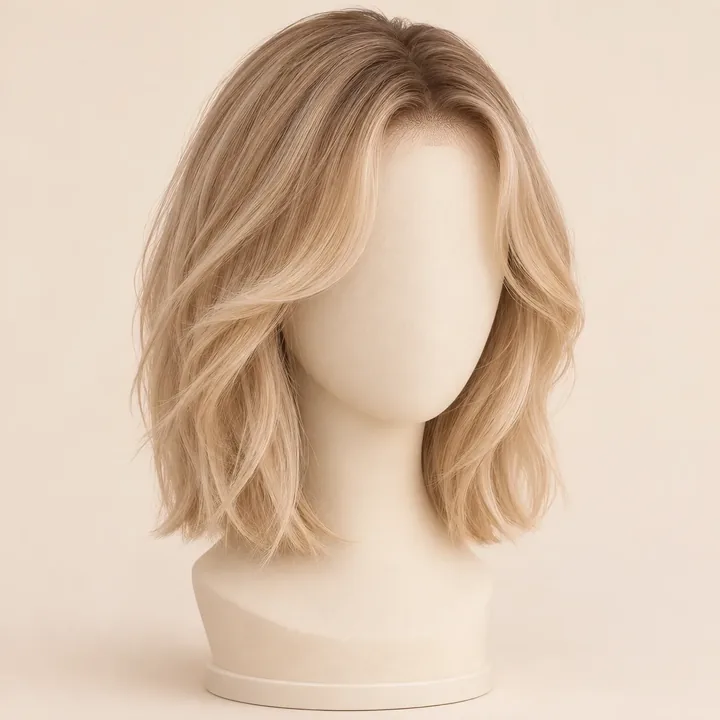
- The sample & photo desk shoots the cap interior in daylight with the rest of the photo set, the size label visible, so you can read it against the size you confirmed.
- You put the sample on a fitting head or on your client, set the straps, and check the five places.
If you already fit a sizeWrite the cap size you use for that client instead of measurements. It is read back against the style in the same way.

Request samples
Request Samples — Send Five Measurements With the Style
Send the style, shade and cap construction with your client's five measurements. Try the sample on her and read the size label in its cap interior photo.
Circumference · front to nape · ear to ear · temple to temple · nape width
Fit · adjusted on the wearer
Cap Fit Adjustment — Nape Straps, Glueless Bands and Clips
Cap size sets the starting fit. The final fit is adjusted on the wearer.
On every cap
Adjustable straps sit inside the cap at the nape. They are set on the client at her fitting, tightened or eased, and released at night.
On a glueless wig
Elastic bands or clips are added so the wig holds without adhesive. Here size does more of the work, so the measurements matter more. See the full glueless fit or request a glueless sample.
Straps and clips cannot turn the wrong size into the right one.
A cap too large moves on the head; a cap too small rides up. That is why the cap size is read back from measurements and tried on a sample first.


Density · read as a look
Wig Density Chart — Lighter, As Listed and Fuller Looks
Each style has a density confirmed from our supply data. On your request you keep it as listed, or ask for lighter or fuller, and say where.
| Direction | How it looks on the head | Where it shows most | Works well for |
|---|---|---|---|
 Lighter | Hair moves easily, the part and hairline look soft, the wig sits close to the head | Hairline, part, ends | Mature clients, clients whose own hair was fine, a softer hairline |
 As listed | The density confirmed for that style in our supply data | Across the whole head | A starting point for most samples |
 Fuller | More volume at the crown and through the lengths, more hair around the face | Crown, mid-lengths, face-framing pieces | Clients whose own hair was thick, longer styles worn down |
The hairline stays fine
It always thins toward the forehead, with single hairs in the first row at the lace edge. Fuller does not make the front edge dense. See Lace Front Human Hair Wigs.
A mono top stays covered
The crown is knotted closely enough to cover the mono wherever the part is moved. Lighter does not open the part to show mesh. See Monofilament Wigs.
Density here is a look, set on a sample you hold. We do not give density as a percentage.
Five places on one cap
Density Across the Cap — Hairline, Part, Crown, Lengths and Ends
A wig is not one density from front to back. Hair is placed differently in each area, and each area is read in its own daylight view.
Illustration · not to scale · the first row at the hairline never changes
Hairline
Fine at the lace edge, building toward the back. Mark it if the edge looks too even or too dense.
Hairline close-up · front view
Part
Enough hair either side that the part reads as scalp without looking sparse. On a rooted shade the part also shows the root color.
Part close-up
Crown
Covers the cap and holds up the part. Too little at the crown shows the cap.
Front and back views
Mid-lengths
On longer cuts, the hair that lies against the face and shoulders.
Front and side views
Ends
Lighter than the mid-lengths on long styles, so the hair moves. On a short cut the ends carry most of the visible density.
Side and back views


Layers and density, set together
Layers take weight out of the hair, so on a layered style the two are set together on the sample. A density mark and a layers mark can sit on the same sample, each naming its place and view.
How to read it
- Fitting head by a window, out of direct sun.
- Front view first, then side.
- Part the hair where your client parts hers.
- Compare each view with its daylight photo.
Seven launch styles
Cap Size and Density by Style — Seven Launch Styles
Cap size and density are confirmed for each of the seven launch styles from our supply data. What each style asks you to check:

Long Layered
Weight at three places, with layers and density set together.
- Crowncovers the cap and holds the part
- Mid-lengthslie against the face and shoulders
- Endslighter than the mid-lengths
Straight with Layers
The same three weight points as Long Layered, read in the front view.
Request this styleNatural / Loose Wave
The wave makes hair look fuller, so density is read on the waved sample. Straight and waved are two combinations, each sampled.
Request this styleBob
Density shows at the ends and the nape; the lower cap edge is close to view, so nape width matters. See Bob Wigs.
Request this style
Lob / Shoulder Length
The hair covers the back of the cap; density is read at the ends on the shoulder.
Request this styleWigs with Bangs
The fringe is full or light, marked under layers. See Wigs with Bangs.
Request this style


All styles are listed with every shade and cap on Human Hair Wigs.
Mature clients
Density for Mature Clients — Softer Hairline, Lighter Cap
Many of your clients are mature women, some with thinning hair of their own. For them, size and density are chosen together with the cap.
Density that suits her
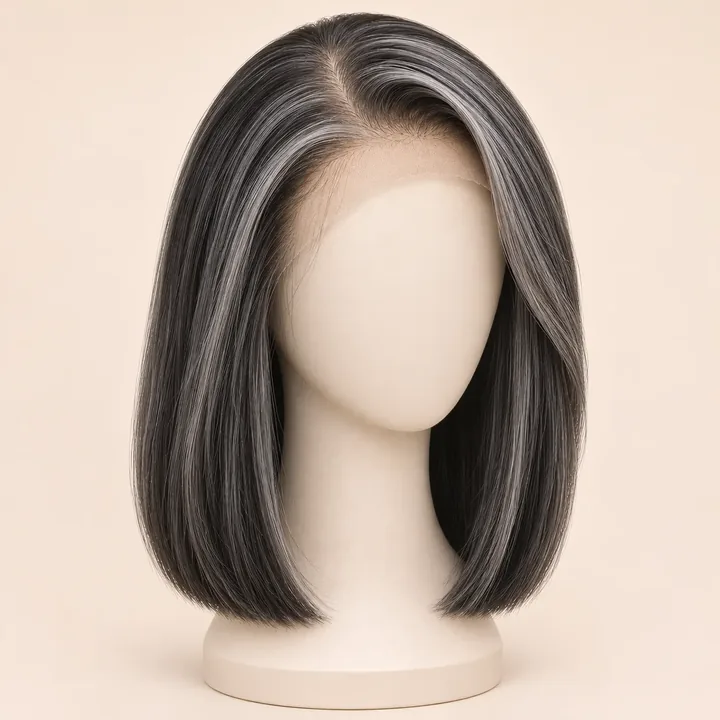
A lighter hairline density gives a softer front, close to a hairline that has thinned with age. Layers and bangs that frame the face carry the look, so the wig does not need volume to read as full. On gray shades, the gray mix and the density are read together in daylight, front, side and back. See Grey Human Hair Wigs and Wigs for Older Women.
A wig put on every day
A light cap with nape straps, and often glueless fitting, suits a client who puts the wig on each morning and takes it off at night. Measure her as she wears it: over her own hair flattened, or on her scalp.
A client with hair loss
Measured in the state she will wear the wig, and fitted on the sample on her own head. The full sizing route is on Medical Wigs.


Discuss wig details
Discuss Wig Details — Plan Sizes per Style With Your Wig Specialist
Talk through sizes per style and the density your clients wear with a wig specialist before you request samples.
One line per wig
Size and Density Request Checklist — What to Send per Wig
This is the list your wig specialist works from. Send it on the form, on WhatsApp, or as a spreadsheet with one line per wig.


For a sample made to one client
- Style, shade and cap construction
- The five measurementsCircumference · front to nape · ear to ear · temple to temple · nape width
- The unit you used: centimeters or inches
- Measured over her own hair flattened, or on a bare scalp; and if she is fitted ahead of hair loss
- Or, instead of measurements, the cap size you already fit her in
- Density: as listed, lighter or fuller, and where
- Her skin tone, for the lace and the monofilament scalp color
- Your store's reference number; we do not need her name
For a range or a brand line
- Each style you plan to carry, and the cap sizes you want it in
- Density for each style: as listed, lighter or fuller
- Which combinations you plan to reorder
Left blankLeave cap size or density blank and your wig specialist confirms them for that style from our supply data and lists them in the reply, so you can confirm or change them before the sample is made.
What you get: one request with everything needed to size the sample, and nothing guessed.
Field · place · direction · view
Marking Size and Density on a Sample — Place, Direction and View
A loose or thin sample gets a mark: field, place, direction, view.
Size and fit marks
- Fit: loose at the temples, front view.
- Fit: cap lifts at the nape, straps fully in, back view.
- Fit: front edge sits behind her hairline, side view.
- Fit: tight behind the ears, cap interior.

Density marks
- Density: lighter at the hairline, hairline close-up.
- Density: fuller at the crown, back view.
- Density: ends too heavy, side view.

- What changes on the revised sample
- Only the marked points. The revised sample comes back with a new daylight photo set, and you keep the photos from every round to compare in the same views. Shade, length, layers, hairline and cap construction stay as they were unless you mark them too.
- Who handles it
- Your wig specialist, the same person who read back your measurements, reads your marks back and asks if a place or view is missing.
After approval
Size and Density on Reorders — Held to the Approved Sample
Once you approve a sample, its cap size and density are part of it. The bulk order is made to it, and so is every reorder. Name the approved sample by style, shade and cap combination; size and density come with it.
Before dispatch, every wig is checked against our reference wig and its daylight photos:
- Size label · cap interior
- Fullness · hairline
- Fullness · part
- Fullness · lengths
A wig that does not match is held back, you are sent photos of it, and it is remade or replaced before it ships. See the full reorder check.
A new size or density on a style you stock is sampled first and approved before bulk. Approved samples already on order are not affected.

Listing · sample
Wig Sizing Comparison — Measured and Sampled vs Size-Chart Listings

| Step | Catalog wig listing | Our cap size and density |
|---|---|---|
| How size is chosen | A size name picked from a chart | Five measurements read against the style by your wig specialist |
| How density is chosen | A fixed density on the listing, or a percentage | A look you choose, lighter, as listed or fuller, by area |
| Before ordering | Listing description and studio photos | A sample wig on your client, with daylight photos and its cap interior |
| If it fits wrong | Found out on arrival | Marked by place on the sample and corrected before approval |
| Reorders | Same size name, same listing | Same approved sample, size label and fullness checked before dispatch |
With a listing, size and fullness are decided when the order arrives. With us, they are decided on the sample, on a head.
Options
Cap Size and Density Options — Can Order, Conditional, Not Used

| Can be ordered | Ordered with a condition | Not used |
|---|---|---|
| The cap size confirmed for any of the seven launch styles from our supply data | A cap size outside what is confirmed for a style: raised with your wig specialist, decided on a sample | Size names or numbers from another supplier's chart, without measurements |
| Density as listed, lighter or fuller, on any style | Density changed in one area only (hairline, crown or ends): named on the request and read on the sample | Density percentages |
| Measurements for one client, or a list of sizes for a range | Fitting ahead of hair loss: sized for how she will wear it, straps set at her fitting | A size approved without trying the sample on a head |
| A size and density you approved before, reordered by name | A new size or density on a stocked style: a new sample first | — |

Start with one client or one range
Request Samples, Discuss Wig Details or Get Wholesale Quote
- Request Samples
Send the style, shade, cap construction and your client's five measurements.
- Discuss Wig Details
Plan sizes per style and the density for your clients with a wig specialist.
- Get Wholesale Quote
List the styles, shades, cap features and sizes you want to stock.
Send it through the form, or on WhatsApp. Your wig specialist replies within working hours and reads your sample list back for you to confirm.
WhatsApp +86 177 0272 7677Call +86 177 0272 7677Mon–Sat 09:00–18:00 (GMT+8)